
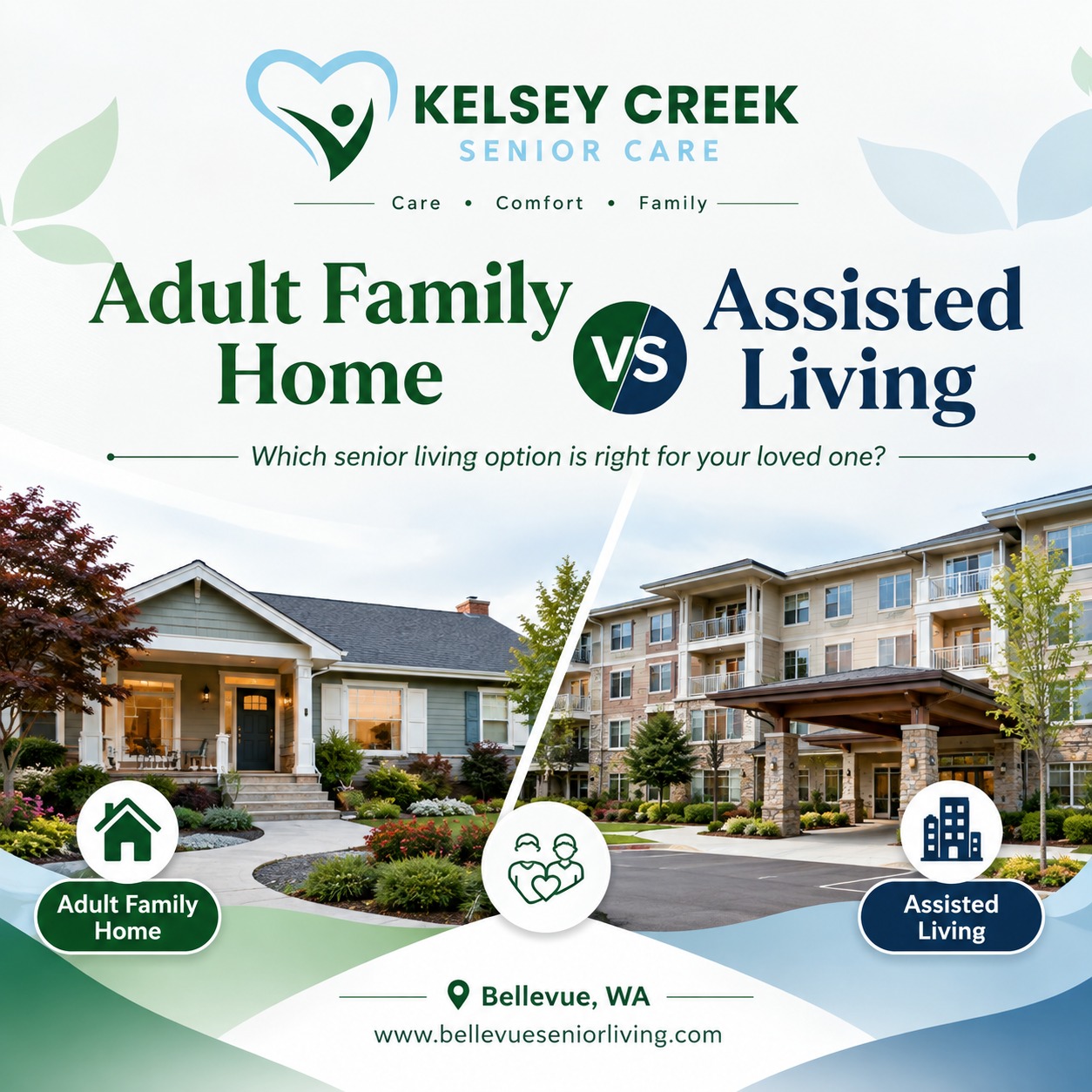
An adult family home (AFH) is a licensed single-family residence caring for up to 6 residents with a high staff-to-resident ratio, while assisted living is a larger, apartment-style community serving dozens to hundreds of residents. AFHs typically cost $4,500-$9,000/month in Washington State, often bundling more care into the base rate than larger assisted living communities.
Table of Contents
ToggleWhat is a Rehabilitation Center?
If you’ve started researching senior care options for a parent or spouse in Bellevue, Sammamish, Redmond, or Issaquah, you’ve probably run into two terms that sound similar but describe very different environments: adult family homes and assisted living facilities. Understanding the difference is one of the most important decisions you’ll make in this process, because it shapes everything from your loved one’s daily routine to the final monthly bill.
Both options are licensed by Washington State and both provide help with daily activities like bathing, dressing, and medication management. But the setting, staffing model, and overall experience differ significantly — and for many Eastside families, that difference changes everything.
What Is an Adult Family Home?
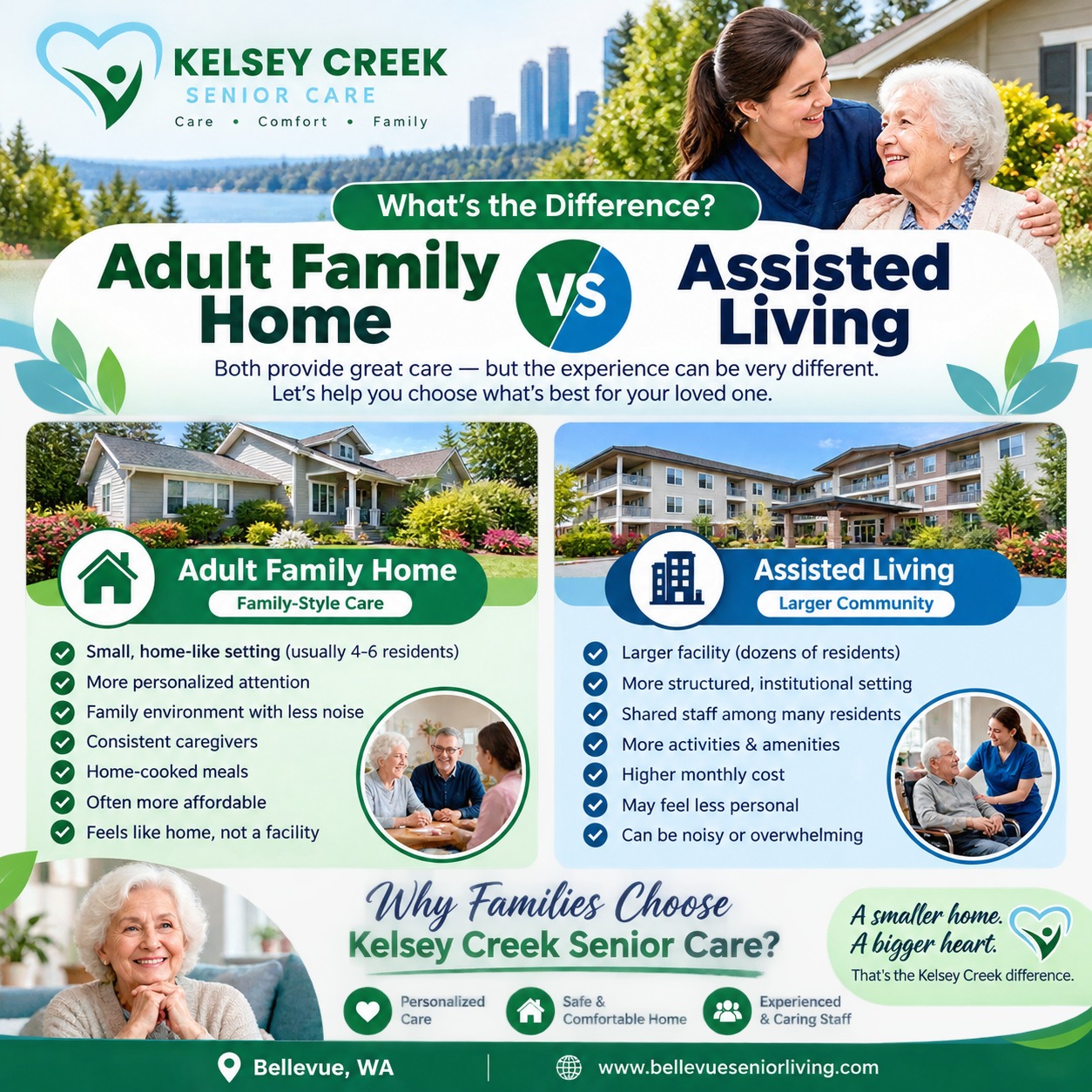
An adult family home (AFH) is a licensed residential care home operating out of a real single-family house, typically in a quiet residential neighborhood. Washington State law caps AFHs at six non-related residents at a time, which means your loved one becomes part of a small, tight-knit household rather than one resident among hundreds.
Kelsey Creek Senior Care, located at 657 130th Ave NE in Bellevue (License #218200), is a licensed AFH that has operated in the same residential neighborhood since 1995. Because we care for a small number of residents, caregivers get to know each person’s routines, preferences, and personality — not just their care plan on paper.
- Licensed for up to 6 residents at a time
- Located in an actual residential home, not an institutional building
- Higher caregiver-to-resident ratio than most large facilities
- Same caregivers see residents daily, building real familiarity
- Meals are typically home-cooked, not cafeteria-style
Looking for a smaller, more personal care home in Bellevue? Learn more about Kelsey Creek Senior Care. Visit our website to learn more or contact us to discuss your family’s needs.
What Is Assisted Living?
Assisted living facilities are larger, apartment-style communities that can house anywhere from 20 to over 150 residents. They typically offer private or semi-private apartments, a dining hall, and a broader range of scheduled group activities and amenities like a hair salon, movie room, or fitness center.
Staffing in assisted living is typically organized in shifts across a large resident population, so residents may interact with a rotating group of caregivers rather than the same one or two people every day.
- Larger, campus-style or apartment-style buildings
- More amenities: dining halls, activity centers, transportation services
- Staff-to-resident ratios vary widely and are typically lower than AFHs
- A broader social community with more organized group activities
- Care plans are typically tiered, with pricing increasing at each tier
Adult Family Home vs. Assisted Living: Side-by-Side Comparison
|
Factor |
Adult Family Home |
Assisted Living |
|
Resident capacity |
Up to 6 residents |
20-150+ residents |
|
Setting |
Single-family residential home |
Apartment-style community/campus |
|
Caregiver familiarity |
Same caregivers daily |
Rotating shift staff |
|
Meals |
Home-cooked, family-style |
Cafeteria/dining hall service |
|
Typical WA monthly cost |
$4,500 – $9,000/month |
$6,300 – $9,500+/month |
|
Amenities |
Minimal — home-like setting |
Extensive — salons, gyms, activity rooms |
|
Best for |
Those wanting individualized, home-like care |
Those wanting a larger social community |
A Closer Look: The Emotional Side of the Decision
Cost and floor plans matter, but for most Bellevue and Sammamish families, the real question underneath this comparison is emotional: will my loved one feel safe, respected, and truly cared for — not just supervised? This is worth sitting with, because the two settings tend to produce very different day-to-day emotional experiences for residents.
In a large assisted living community, your loved one becomes one of many residents on a shift-based caregiving model. That’s not a criticism — many people thrive in that structure, especially those who value independence and a wide social circle. But for someone who is anxious, easily overstimulated, or in the early-to-moderate stages of cognitive decline, being one of 60 or 100 residents can feel disorienting rather than comforting.
An adult family home flips that dynamic. With only five or six residents total, caregivers aren’t managing a caseload — they’re getting to know individual people. They learn that Mrs. Chen prefers her tea a certain way, that Mr. Alvarez gets anxious around loud noises in the evening, and that today is the anniversary of a spouse’s passing and extra gentleness is needed. That kind of familiarity typically only develops in a small-household setting, and it’s one of the most consistent things we hear from families after their loved one moves in.
Which One Is Right for Your Loved One?
There’s no universally “better” option — the right choice depends on your loved one’s personality, care needs, and what kind of environment helps them feel safest and most at home.
Consider an adult family home if your loved one gets overwhelmed in large groups, needs a higher level of individualized attention, has moderate-to-advanced memory care needs, or simply prefers a quiet, residential setting that feels like a real home rather than a facility.
Consider assisted living if your loved one is highly social, wants access to a wide range of group activities and amenities, or prefers more independence with the option to be around a larger community of peers.
Still comparing your options? A personal tour can help you see the difference between a large assisted living community and a smaller adult family home. Schedule a no-pressure tour with Kelsey Creek Senior Care and see our Bellevue home for yourself.
How Kelsey Creek Senior Care Compares
At Kelsey Creek Senior Care, we’ve operated as a family-owned adult family home in Bellevue since 1995 supporting families throughout Bellevue, Sammamish, Redmond, Issaquah, and Kirkland through every stage of aging. Because we care for a small number of residents at a time, our team gets to know each resident personally, and families get direct, transparent communication rather than navigating a large corporate structure.
We offer assisted living, memory care, respite care, and hospice support — all within the same home-like, licensed setting. If you’re weighing your options and want to see how an adult family home compares in person, we welcome you to schedule a tour.
Questions to Ask Yourself Before Deciding
Beyond comparing the two models on paper, it helps to ask a few honest questions about your specific loved one and situation:
- Does my loved one get anxious or overwhelmed in crowds or unfamiliar group settings?
- How important is it to my loved one to have access to a large variety of organized activities and outings?
- Is my loved one currently in the early, moderate, or advanced stage of any cognitive decline?
- What is our realistic monthly budget, and how does that change if care needs increase over the next 1-2 years?
- Would my loved one feel more at home in an actual house, or do they want the feel of a larger community campus?
Making the Final Decision With Confidence
Whichever direction you lean, give yourself permission to take the time this decision deserves. Tour more than one home of each type if your timeline allows it. Ask the same detailed questions everywhere you go (our companion checklist, ‘Adult Family Home Tour Checklist: 15 Questions to Ask,’ walks through exactly what to ask). And most importantly, involve your loved one in the process as much as their condition allows — their comfort and sense of dignity in this transition matters as much as any factor on this list.
If you’d like to see how an adult family home setting compares in person, Kelsey Creek Senior Care welcomes Bellevue, Sammamish, Redmond, and Issaquah families to schedule a no-pressure tour at (425) 453-2053.
FAQs
Often, yes. Adult family homes in Washington typically run $4,500-$9,000/month, while assisted living communities average $6,300-$9,500+/month. However, AFHs often bundle more care into the base rate, so the real cost gap can be smaller than the headline numbers suggest.
Washington State law limits adult family homes to six non-related residents at a time, which is why the caregiver-to-resident ratio is typically much higher than in large assisted living communities.
Yes, many licensed adult family homes, including Kelsey Creek Senior Care, provide memory care for residents with Alzheimer's or dementia, often with more individualized supervision than larger memory care wings.
Many adult family homes accept Medicaid through Washington's COPES waiver program for residents who qualify financially and medically — ask any home directly about their specific Medicaid arrangements.
Yes, many families start in one setting and transition as needs or preferences change. It's worth discussing transition support with any home you're considering, including how they handle the process of finding a new placement if your loved one's needs eventually exceed what they can provide.
Ready to explore your senior care options in Bellevue or Sammamish? Call us today at (425) 453-2053 to discuss your loved one’s needs and find out if our adult family home is the right fit for your family.